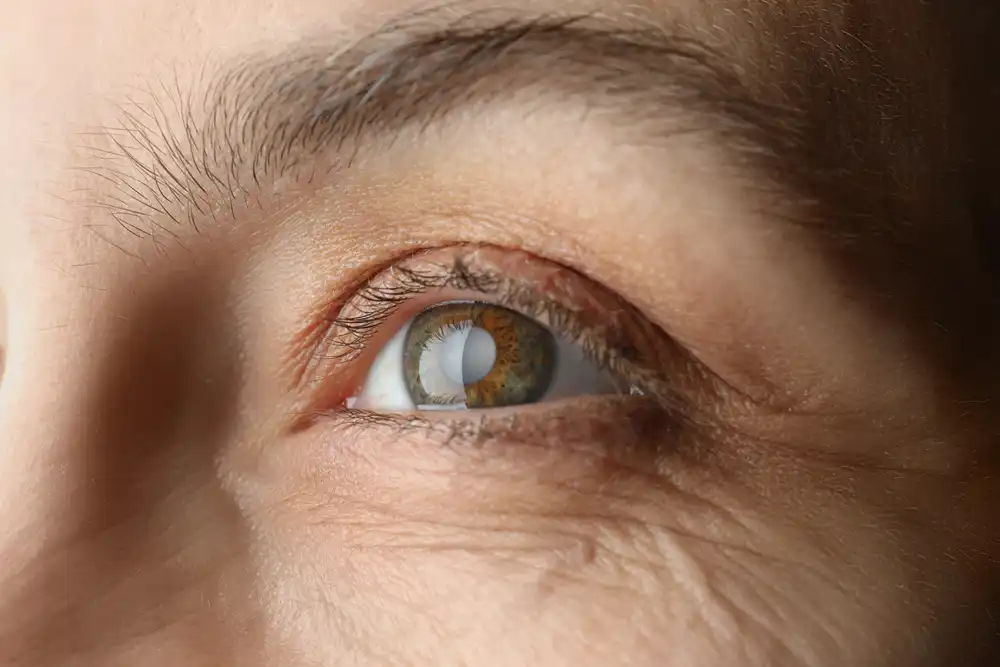
Keratoconus
Specialist care and tailored management options, ranging from glasses and specialised contact lenses to advanced clinical treatments, are designed to protect vision and maintain clarity at every stage of the condition. Professional guidance provides the necessary support and expertise to help individuals manage their eye health with confidence and continue living life without limits.

Keratoconus Eye
Keratoconus is an eye condition where the normally round, dome-shaped cornea becomes thin and gradually bulges outward into a cone-like shape. This irregular curve prevents light from focusing properly on the retina, causing distorted and blurred vision.
Mr. Manu Mathew
Consultant Ophthalmic Surgeon
Mr. Mathew is a highly trained ophthalmic surgeon specialising in cataract, refractive lens, and laser eye surgery including LASIK and LASEK. He has performed hundreds of successful procedures and is well-regarded for his expertise across Nottingham, Birmingham, Leeds, and Wetherby.





Symptoms of Keratoconus
Keratoconus usually develops in the late teens or early 20s and can progress over time. Common signs include:
- Blurred or distorted vision
- Increased sensitivity to light and glare
- Frequent changes in glasses prescription
- Ghosting or double vision (especially at night)
- Difficulty driving at night
- Eye rubbing due to irritation or allergies
How Keratoconus Progresses
Keratoconus might get worse over time because it is a progressive disorder.
Early on, vision correction may be achieved with glasses or soft contact lenses.
Rigid gas permeable (RGP) or scleral contact lenses may be necessary for vision as the cornea becomes more irregular.
In more severe cases, surgery can be required.
Read our latest articles